

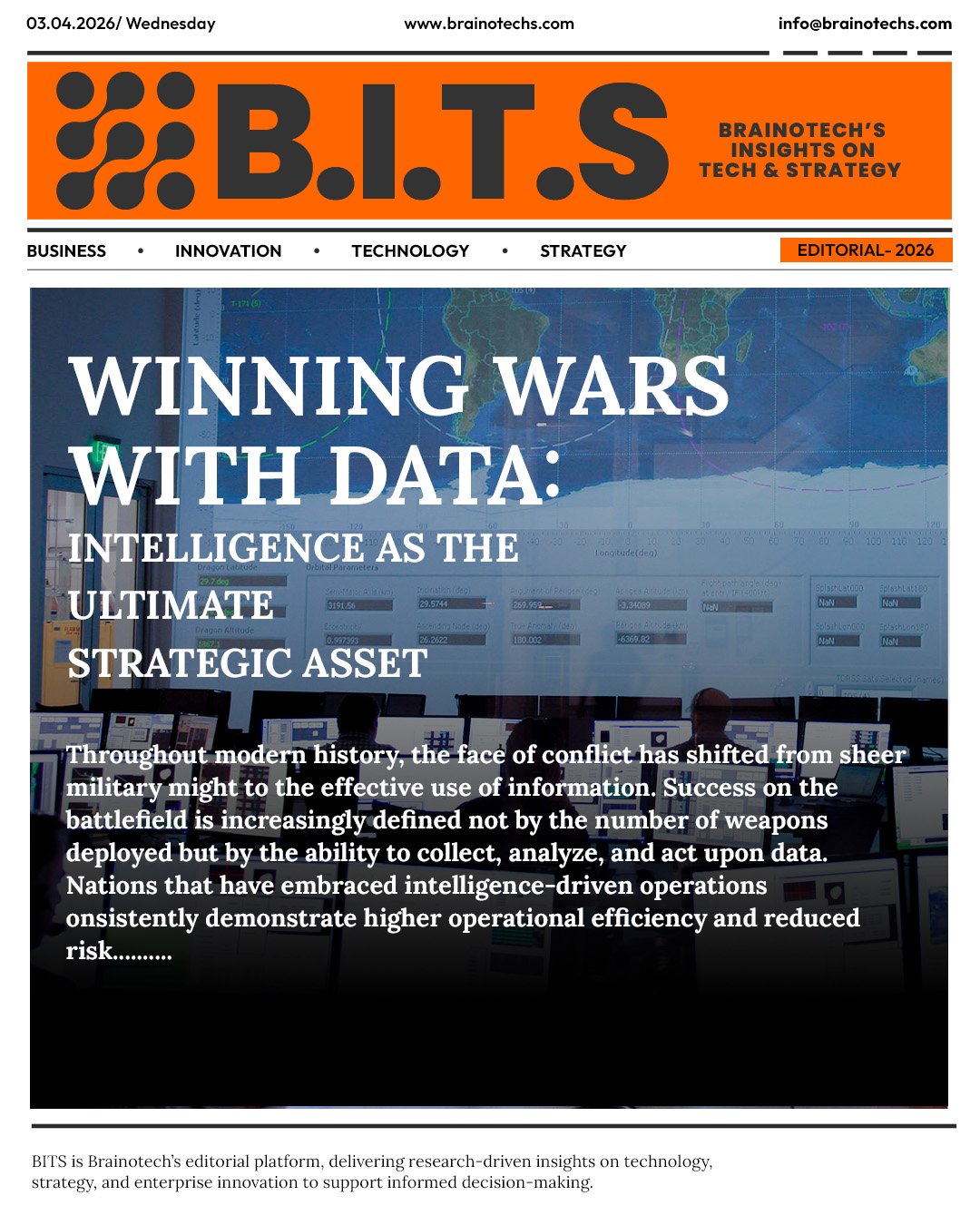
Throughout modern history, the face of conflict has shifted from sheer military might to the effective use of information. Success on the battlefield is increasingly defined not by the number of weapons deployed but by the ability to collect, analyze, and act upon data. Nations that have embraced intelligence-driven operations consistently demonstrate higher operational efficiency and reduced risk.
In this context, Brainotech IT Solutions has developed a keen observation of global trends, leveraging insights into how data and predictive analytics have shaped operational decisions over time. This article presents a comprehensive historical and current analysis of how intelligence has redefined strategy, enabling nations to anticipate challenges, prevent crises, and optimize outcomes without relying solely on conventional firepower.
The origins of this paradigm can be traced to the early 20th century. During World War II, Allied efforts in cryptanalysis, led by Alan Turing and the teams at Bletchley Park, transformed intercepted communications into actionable strategies. By decoding encrypted messages, the Allies could anticipate enemy movements, optimize supply routes, and safeguard critical operations. A retrospective analysis shows that Allied shipping losses in the Atlantic declined sharply from 1942 to 1944, reflecting the direct impact of strategic intelligence. These historical milestones set the foundation for modern concepts of data-driven strategy, demonstrating that even in the most complex operational environments, systematic analysis of information can generate a decisive advantage.
| Year | Allied Shipping Losses (Ships Sunk) | Impact of Intelligence Integration |
| 1941 | 780 | Minimal code-breaking success |
| 1942 | 1,200 | Increased U-boat threat |
| 1943 | 650 | Breakthrough in Enigma decoding |
| 1944 | 400 | Intelligence-guided convoy routing |
By the 1960s, the advent of aerial reconnaissance and satellite imagery expanded the ability of nations to gather actionable intelligence from afar. The deployment of U-2 reconnaissance planes over contested regions provided unprecedented visibility into potential threats. Satellite imagery programs allowed for real-time mapping of troop movements and strategic assets, giving planners the ability to anticipate operations before they unfolded. These early implementations of spatial intelligence laid the groundwork for predictive analytics, enabling military and corporate strategists alike to transform raw observational data into operational foresight.
The Gulf War in 1991 marked a turning point in digital warfare. With the integration of satellite imagery, GPS navigation, battlefield sensors, and networked command centers, General Norman Schwarzkopf executed a campaign that prioritized precision and efficiency over mass mobilization. Operational data showed dramatic reductions in decision-to-action cycles, from seventy-two hours in traditional engagements to six hours in digital operations. Targeting accuracy soared from approximately forty percent to nearly eighty-seven percent, while collateral damage incidents were reduced by more than sixty percent. These metrics demonstrated the transformative power of intelligence integration.
| Metric | Pre-Digital Era Average | Gulf War Result |
| Decision-to-Action Time | 72 hours | 6 hours |
| Target Accuracy | 40% | 87% |
| Operational Collateral Impact | High | Reduced by 65% |
During the conflicts in Afghanistan and Iraq from 2001 onwards, intelligence-driven operations reached new heights with the deployment of fusion centers. These centers combined signals intelligence, human intelligence, drone reconnaissance, and open-source data to generate predictive insights. Advanced machine learning models identified high-risk zones, optimized patrol routes, and forecasted potential insurgent activity. Statistical evaluations indicated that predictive intelligence reduced surprise attacks by over fifty percent in key regions, while civilian casualties declined by approximately thirty percent where integrated data systems were deployed. This marked a shift from reactive military strategies to proactive, data-informed operations.
During the conflicts in Afghanistan and Iraq from 2001 onwards, intelligence-driven operations reached new heights with the deployment of fusion centers. These centers combined signals intelligence, human intelligence, drone reconnaissance, and open-source data to generate predictive insights. Advanced machine learning models identified high-risk zones, optimized patrol routes, and forecasted potential insurgent activity. Statistical evaluations indicated that predictive intelligence reduced surprise attacks by over fifty percent in key regions, while civilian casualties declined by approximately thirty percent where integrated data systems were deployed. This marked a shift from reactive military strategies to proactive, data-informed operations.
The modern era of intelligence-led operations is exemplified by global security challenges since 2022. Contemporary conflicts demonstrate the extensive use of real-time satellite imagery, open-source intelligence, AI-based predictive modeling, and advanced signal analysis. Countries with integrated intelligence frameworks are able to anticipate escalations, optimize logistics, and reduce operational risk. In recent operational theaters, early warning systems reduced civilian displacement by nearly eighteen percent, while strategic decision cycles improved by over forty percent, demonstrating the operational and humanitarian benefits of intelligence integration.
| Sector | Estimated Investment (USD Billion, 2030 Projection) |
| AI and Predictive Analytics | 115 |
| Cybersecurity Infrastructure | 98 |
| Satellite Intelligence Systems | 87 |
| Secure Communication Networks | 65 |
| IoT-based Sensor Networks | 55 |
The IT industry plays a pivotal role in this transformation. Artificial intelligence, cloud computing, geospatial platforms, and cybersecurity infrastructures are integrated with operational frameworks to enhance situational awareness and enable rapid decision-making. Cloud platforms allow secure, real-time data sharing across multiple operational nodes, while AI algorithms support predictive modeling and anomaly detection. These technological advancements bridge the gap between raw data and actionable strategy, enabling organizations to optimize performance and respond proactively in complex environments.
Historical analysis also emphasizes that data-driven approaches are not limited to combat operations. Predictive analytics have been applied to border management, risk mitigation, and operational planning, allowing organizations to allocate resources efficiently, minimize risk exposure, and enhance resilience. Lessons from the past indicate that nations and organizations capable of harnessing data in a structured, scalable manner gain a sustainable strategic advantage over those that rely on reactive, resource-intensive approaches.
The convergence of historical precedent, operational case studies, and contemporary technological advancement underscores a key lesson: intelligence-driven strategy is not an auxiliary tool but a core asset. Operational superiority now depends on the ability to anticipate and respond proactively, leveraging data as a force multiplier. Organizations that fail to integrate advanced analytics risk slower decision cycles, suboptimal resource utilization, and higher operational vulnerability.
Evolution of intelligence-driven strategy demonstrates that victory is increasingly determined by insight, foresight, and the capacity to act on information. From the cryptanalysis successes of World War II to predictive analytics in contemporary operational theaters, data remains the defining factor in strategic decision-making. Structured intelligence, predictive modeling, and real-time analytics are essential for maintaining operational effectiveness and strategic advantage.
Victory in this era is no longer measured solely by physical resources or conventional assets but by the ability to convert information into actionable strategy, anticipate challenges before they arise, and maintain agility across diverse operational landscapes. The future belongs to those who not only gather data but transform it into intelligence that drives informed, effective, and timely decisions.
